5 Ways Small Businesses Can Use AI Without Replacing Staff
AI for small business without replacing staff: 5 practical ways Orange County SMBs use ChatGPT, Claude, and automation to help teams work smarter.
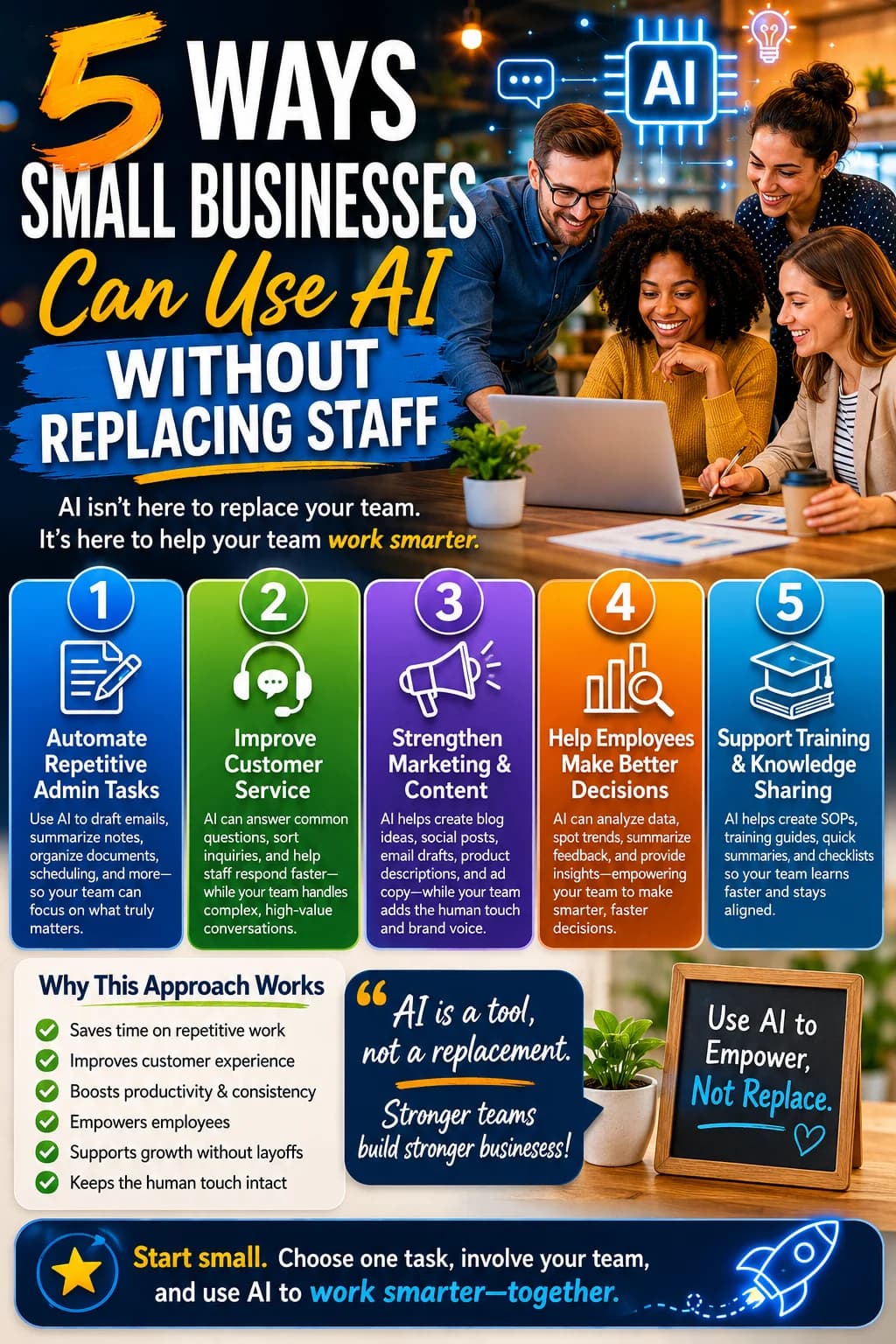
Most small business owners I talk to in Orange County have the same first question about AI: "Am I going to have to fire someone?"
The answer is no — and the framing is wrong. The owners winning with AI right now are the ones using it as a force multiplier for the team they already have. Not a replacement. A multiplier. Same five employees, but each one is now getting through their work in half the time and spending the rest of it on the parts of the job that actually move the business.
This article walks through five concrete ways AI for small business without replacing staff actually works — with the specific tools, the specific tasks, and what to try first.
Why staff replacement is the wrong frame
The headlines about AI replacing knowledge workers are written about Fortune 500 companies that have entire departments doing repetitive document review. That's not your business. Your business is a 4-person dental office in Newport Beach, an 8-person HVAC company in San Clemente, a 12-person law firm in Irvine. You don't have redundant headcount. You have people wearing three hats each.
A 2024 McKinsey report on small business AI adoption found that the SMBs getting real productivity gains from AI are overwhelmingly using it for task augmentation, not headcount reduction. Translation: AI is doing the boring 30% of each role so your people can do the valuable 70% better.
That's the entire game. Five practical ways to play it are below.
5 ways small businesses can use AI without replacing staff
1. Automate repetitive admin tasks
This is where every small business should start. Admin work — drafting emails, summarizing meeting notes, organizing documents, scheduling — eats 8 to 12 hours per employee per week in most SMBs.
The tools: ChatGPT or Claude for drafting and summarizing. Zapier or n8n for connecting your apps so a customer form submission becomes a calendar invite, a CRM entry, and a Slack notification without anyone touching it.
Concrete scenario: a San Clemente auto shop has the service advisor spending an hour every morning writing follow-up texts to yesterday's customers. With a Claude prompt that pulls the work order details and drafts a personalized message, that hour becomes 10 minutes. The advisor still reviews and sends — the human touch stays — but the typing is gone. That's 4 hours back per week, per person.
For deeper workflow projects across multiple apps, our business automation services wire AI into the tools you already use.
2. Improve customer service
AI doesn't replace your customer service rep. It makes one rep as responsive as three.
The tools: AI chatbots on your website for FAQ deflection (Intercom Fin, Drift, or a custom Claude-powered widget). AI phone handling for after-hours and overflow calls — we build these on FreeSWITCH with the OpenAI Realtime API. Email triage tools that pre-sort inbound messages by intent and urgency.
The pattern that works: AI handles the 60% of inbound that's "what are your hours, where are you located, do you service my zip code." Your human team handles the 40% that's actual problems, complaints, or high-value sales conversations. Customer wait times drop, your staff stops getting interrupted by easy questions, and nobody loses a job.
If your phone is the bottleneck, our AI phone receptionist is the most direct fix — it takes calls 24/7, books appointments, and routes the calls that actually need a human to your team.
3. Strengthen marketing and content
This is where small businesses gain the most ground against bigger competitors. A 5-person company can now produce content at the same cadence as a 50-person company — without hiring an agency.
The tools: ChatGPT or Claude for blog drafts, social posts, email campaigns, and ad copy. Canva's AI features for graphics. Descript for video editing and repurposing.
What this looks like in practice: a Newport Beach real estate team that used to publish one blog post a month now publishes one a week. The agent still writes the outline and the personal stories — the human touch and brand voice stay intact — but Claude handles the first draft and the SEO formatting. The agent edits in 20 minutes instead of writing for 3 hours.
The trap to avoid: don't let AI write your entire voice. Use it for structure, drafts, and ideas. Always edit. AI-only content reads like AI-only content, and your customers can tell.
4. Help employees make better decisions
AI is very good at one specific business task most small businesses ignore: looking at a pile of unstructured data and telling you what's in it.
The tools: ChatGPT with Advanced Data Analysis or Claude with file uploads for ad-hoc analysis. Tools like Hex or Julius for ongoing data work. AI features inside QuickBooks, HubSpot, and Shopify for trend spotting.
Concrete example: a 6-person retail shop in Orange County exports 18 months of sales data into Claude and asks "what products are trending up, what's trending down, and what should I stop carrying?" In 90 seconds they get an answer that would have taken their bookkeeper a full day. They still make the call on what to do — but they make it with better information.
This is the category small businesses underuse the most. You don't need a data scientist. You need to start asking your sales reports, customer feedback exports, and review summaries the questions you've been too busy to answer yourself.
5. Support training and knowledge sharing
Most small businesses have zero documented processes. The senior tech knows how to do the thing. The senior tech is on vacation. Nobody else can do the thing.
The tools: ChatGPT or Claude to convert a 15-minute Loom video into a written SOP. AI-powered knowledge bases like Notion AI or Guru. Voice-to-text tools like Otter for capturing tribal knowledge from your senior team.
The play: sit your most experienced employee down for an hour, record them walking through their three most important workflows, and let AI turn those recordings into checklists, training guides, and quick-reference docs. What used to be a documentation project nobody had time for is now a one-afternoon task.
New hires onboard faster. Existing staff stay aligned. The business stops being held hostage by one person's memory.
Why this approach actually works
- Saves time on repetitive work. Every hour your team isn't typing the same email for the 200th time is an hour they can spend on something only a human can do.
- Improves customer experience. Faster response times, fewer dropped balls, more personalized follow-up. Customers notice.
- Boosts productivity and consistency. AI doesn't have bad days. It produces the same quality draft on Friday afternoon as Monday morning.
- Builds confidence in your team. People who learn AI tools at work become more valuable, not less. They know it, and they appreciate that you're investing in them.
- Supports growth without layoffs. You can double revenue without doubling headcount. That's how small businesses scale into mid-sized ones.
- Keeps the human touch intact. AI drafts. Humans decide, edit, and send. The relationship with your customer stays human.
AI is a tool, not a replacement. Stronger teams build stronger businesses.
How to start (without breaking what works)
Three steps. That's the entire plan.
1. Pick one task. Not five. One. The single most repetitive, time-eating task in your business right now. Email drafting, customer follow-ups, meeting notes, scheduling, invoice categorization — whatever it is, pick the one that bugs you most.
2. Involve the team. Tell them what you're trying, why, and that the goal is to give them time back — not to evaluate whether you need them. Let the person who does that task lead the pilot. They know the edge cases better than you do.
3. Measure for two weeks, then expand. Track time saved, errors caught, customer response time — whatever the relevant metric is for that task. If the numbers move, add a second task. If they don't, try a different tool or a different prompt before giving up.
If you want a structured starting point for your specific business, we run a free AI readiness audit that maps the highest-ROI tasks in your operation in about 45 minutes. No commitment, no pitch deck — just a list of what to try first.
Start small. Start with your team.
Use AI to empower, not replace. Choose one task this week, involve the person who owns it, and measure for two weeks. That's how small businesses build durable AI advantages without firing anyone.
If you want to watch a few of these workflows running before you try to build your own, see it in action — we keep working examples of AI receptionists, automation flows, and content pipelines live on the demos page.
And if you want one practical AI idea for small business owners delivered every two weeks, sign up for The Stack Report newsletter. No fluff, no hype — just what's actually working in real Southern California small businesses right now.
The Stack Report is biweekly. No fluff. Real tools small businesses actually use.