Business Automation Consulting for Small Business: What It Is, What It Costs, and What Actually Works
A practical guide to business automation consulting for small businesses in South Orange County — real workflows, tools, costs, and where AI actually pays off.
If you run a service business — a dental practice, an HVAC company, a plumbing shop, a restoration firm — you already know where your time goes. It goes to the phone that rings while you're under a sink. It goes to the lead that filled out your contact form on Saturday and got a reply on Tuesday. It goes to typing the same customer information into three different systems.
Business automation consulting exists to get that time back. But most of what's written about it is aimed at mid-market companies with IT departments and six-figure transformation budgets. This guide is for the rest of us: owner-operated businesses in South Orange County and North San Diego County doing $500K to $10M a year, where the owner is the operations department.
I'm going to cover what an automation consultant actually does, which automations pay for themselves fastest for local service businesses, what this realistically costs, and — because we're in California — the compliance rules around call recording and texting that most out-of-state consultants don't even know exist.
What a Business Automation Consultant Actually Does
Strip away the jargon and the job is simple: find the repetitive work that's costing you money, and build systems that do it for you.
In practice, that breaks into three parts:
1. Diagnosis. A good consultant starts by mapping how work actually flows through your business — not how it's supposed to flow. Where do leads come in? Who answers the phone at 2 PM on a Wednesday? What happens to the voicemail nobody checks? For most small service businesses, this takes days, not months, because the bottlenecks are painfully obvious once someone looks at them from the outside.
2. Build. This is where the tools come in — connecting your phone system, your CRM, your calendar, your invoicing, and your website so information moves between them without a human retyping it. At Stack Consulting AI, our business automation stack is built on tools like n8n for workflow orchestration, Twilio for calls and texting, Supabase for data, and modern AI voice platforms for answering phones. The specific tools matter less than the principle: every system you use should talk to every other system you use.
3. Handoff and support. Automation that your team doesn't use is worthless. The last part of the job is training, documentation, and ongoing monitoring — because phone carriers change rules, APIs change, and your business changes.
The difference between a good consultant and an expensive mistake usually comes down to one question: do they start with your business problem, or with the software they want to sell you? If someone leads with a platform pitch before they've asked how many calls you miss in a week, keep looking.
The Single Biggest Leak in Most Local Service Businesses: Missed Calls
Here's the number that changed how we prioritize automation projects: industry studies consistently find that a large share of calls to small home-service businesses go unanswered — often a quarter or more — and the majority of callers who hit voicemail don't leave a message. They call the next company on the list.
Do the math on your own business. If your average job is worth $400 and you miss ten calls a week, even a modest close rate means you're leaving thousands of dollars a month on the table — not because your marketing failed, but because nobody picked up.
This is why, when a South Orange County contractor or practice asks us where to start, the answer is almost never "a new CRM." It's the front door:
Missed-Call Text-Back
The simplest high-ROI automation in existence. When a call goes unanswered, the caller instantly receives a text: "Hi, this is Paul's team — sorry we missed you! How can we help?" That one message converts a lost caller into a live text conversation. It's cheap to run, takes days to deploy, and it's the entry point we recommend to nearly every service business we work with.
AI Voice Receptionist
The next layer up. Instead of voicemail, an AI receptionist answers the call, speaks naturally, answers common questions ("Do you handle water damage?", "Are you taking new patients?"), captures the caller's name, number, and issue, and can book directly onto your calendar. Modern voice AI platforms have crossed the threshold where callers have normal conversations with them — this is no longer the robotic phone tree you're imagining, and you can hear one of ours on our demos page.
We've deployed these for businesses ranging from home-service contractors to a dental practice, and the pattern is consistent: the AI doesn't replace your front desk. It catches everything your front desk can't — after hours, during lunch, when both lines are busy, on weekends. Every one of those catches used to be a lost lead.
The Lead Dashboard
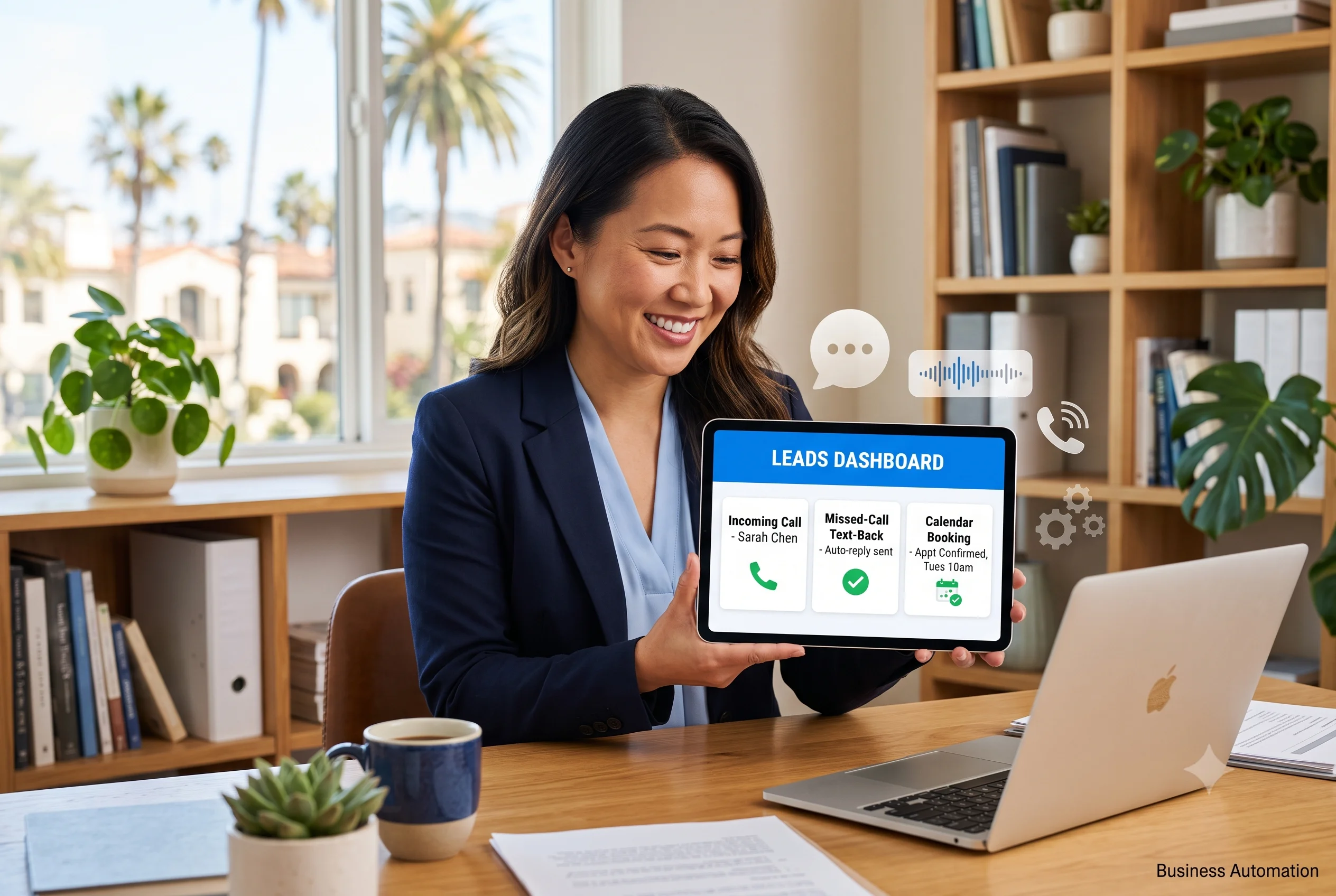
Both of the above feed a single dashboard where every call, text, and form fill lands in one place, timestamped, with the conversation attached. No more "did anyone call that guy back?" Every lead has a status, and nothing falls through the cracks.
Where Automation Pays Off Next
Once the front door is fixed, these are the workflows that deliver the fastest returns for small businesses, roughly in order:
Appointment reminders and confirmations. Automated text reminders cut no-shows dramatically for practices and reduce wasted truck rolls for contractors. This is a solved problem that most small businesses still handle manually or not at all.
Review requests. After a completed job or visit, an automatic text asks the happy customer for a Google review. Local search rankings are heavily influenced by review volume and recency, so this automation compounds — it makes all your other marketing work better.
Quote and invoice follow-up. A shocking amount of revenue dies in the "I sent the estimate and never heard back" pile. A simple automated sequence — a text at day two, an email at day five — recovers deals that were never really lost, just forgotten.
Intake and data entry. New customer information entered once, flowing automatically into your CRM, your invoicing system, and your job schedule. Every retype you eliminate removes an error and saves minutes that add up to hours.
After-hours triage. For trades with emergency work (plumbing, restoration), an AI agent that can distinguish "my water heater is leaking into the garage right now" from "I'd like a quote for a remodel" — and escalate the first to your on-call tech while booking the second for Monday — is worth its cost many times over.
What's not on this list: enterprise workflow platforms, twelve-month "digital transformation" roadmaps, and rip-and-replace software migrations. Small businesses rarely need them, and they're where automation budgets go to die.
What Business Automation Consulting Costs
Straight answers, because this is the question everyone actually has:
Hourly consulting in this space typically runs $100–$300/hour depending on the consultant's depth. Fine for advice and small fixes; unpredictable for real projects.
Fixed-price builds are what we recommend for defined projects. A missed-call text-back system with a lead dashboard is a low-four-figure build. A full AI voice receptionist with calendar booking, CRM integration, and compliance configuration is a mid-four-figure to low-five-figure project depending on complexity.
Monthly managed service is how most of our clients operate long-term: a flat monthly fee that covers the software, phone/usage costs, monitoring, and ongoing improvements. For a small service business, this usually lands in the range of a few hundred dollars a month — a fraction of one recovered job.
The evaluation is simple: what does one missed customer cost you, and how many do you miss a month? If a system that costs $300/month recovers two $400 jobs, it's not an expense. Everything we build gets held to that standard.
The California Compliance Problem Nobody Tells You About
Here's where working with a local consultant genuinely matters, and where generic national advice can get you sued.
California is a two-party consent state. Under the California Invasion of Privacy Act (CIPA), recording or capturing a phone conversation generally requires consent from all parties. That has direct implications for AI phone systems: recent California litigation has targeted businesses whose AI voice systems captured audio before the caller was informed and consented. If your AI receptionist starts processing the call before a disclosure plays, you have exposure. Your system needs to be configured so that disclosure and consent come first — this is a build-time configuration decision, not something you bolt on later.
Business texting is regulated too. The TCPA governs automated texting nationally, and the carriers enforce their own layer through A2P 10DLC registration — if your business number isn't properly registered for application-to-person messaging, carriers will filter or block your texts entirely, and your "automation" silently stops working. We register and configure this as part of every texting deployment because it isn't optional.
Healthcare adds HIPAA. If you're a dental or medical practice, any AI system that touches patient information needs a signed Business Associate Agreement with the platform vendor and HIPAA-compliant configuration. Not every voice AI platform offers this; the ones that do require it to be explicitly activated. This is a hard requirement we handle before a healthcare deployment goes live, not after.
Ask any prospective automation consultant how they handle CIPA consent, A2P 10DLC registration, and (if you're a practice) HIPAA BAAs. If you get a blank stare, that consultant learned automation from YouTube and hasn't deployed in California healthcare or home services. The technology is the easy part; deploying it lawfully is the craft.
How an Engagement Actually Works
Here's our process at Stack Consulting AI, which is representative of how a well-run small-business engagement should go:
Week 1 — Discovery call and audit. A conversation about your business, followed by a look at your call volume, lead sources, and current tools. We identify the two or three automations with the fastest payback and give you a fixed price.
Weeks 2–3 — Build and test. We build the workflows, connect your systems, configure compliance (consent disclosures, 10DLC registration, HIPAA mode where applicable), and test against real scenarios — including the weird ones, like the caller who interrupts, the after-hours emergency, and the spam call.
Week 4 — Launch and training. The system goes live, your team gets a walkthrough, and you get plain-English documentation. Then we watch it: the first two weeks of real calls always surface refinements.
Ongoing — Monitor and improve. Monthly reporting on calls answered, leads captured, and appointments booked, plus continuous tuning. Automation isn't a product you buy once; it's a system that gets better with feedback.
Notice what's missing: a six-month discovery phase, a steering committee, and a change-management workshop. Small businesses don't need transformation theater. They need working systems, fast.
Frequently Asked Questions
Will an AI receptionist annoy my customers?
Configured well, no — because the alternative it replaces is voicemail, and callers hate voicemail more than anything. The AI answers instantly, sounds natural, gets their issue handled or booked, and hands complex situations to a human. The businesses that get complaints are the ones using AI to avoid customers; the ones that win use it to make sure no customer is ever ignored.
I'm not technical. Will I be able to manage this?
You don't manage the plumbing; you see the results. Your interface is a simple dashboard of leads and appointments, plus notifications on your phone. The workflows, integrations, and monitoring are our job — that's what the managed-service model is for.
Can't I just do this myself with Zapier?
You can, the same way you can do your own bookkeeping. Some owners genuinely enjoy it. The catch is the parts that don't show up in tutorials: carrier registration, California consent requirements, error handling when an API changes at 11 PM, and knowing which of the forty possible automations actually matter for your business. Most owners who DIY get 70% of the way there and then it quietly breaks. If you want to try, start with missed-call text-back — and call us when you're ready to make it bulletproof.
How is this different from GoHighLevel or other all-in-one platforms?
Those platforms are toolkits — powerful ones. But a toolkit isn't a solution, and most small business owners don't want a second job configuring marketing software. We build on proven components, tailor them to your actual workflow, handle the compliance layer, and stay accountable for the system working. You own the outcome, not the tooling — and you're never the one debugging it at 11 PM.
Do you only work with businesses in Orange County?
Our home base is San Clemente and most of our clients are in South Orange County and North San Diego County — Dana Point, San Juan Capistrano, Mission Viejo, Laguna Niguel, Oceanside, Carlsbad, Vista. Local matters for this work: we know the market, we can meet in person, and we understand California's rules because we operate under them ourselves. That said, the systems we build work anywhere, and we take remote clients when there's a fit.
What's the fastest win if I only do one thing?
Missed-call text-back. It deploys in days, costs little, and directly recovers revenue you're currently losing. It's also the best way to test what working with us is like before committing to anything bigger.
Ready to Find Out How Many Leads You're Missing?
Stack Consulting AI builds AI phone systems and business automation for service businesses in South Orange County and North San Diego County. Book a free call audit — we'll look at your real call volume and show you exactly what's slipping through, no pitch deck required. Get in touch →
The Stack Report is biweekly. No fluff. Real tools small businesses actually use.